8 Best Collabstr Alternatives in 2026
Collabstr alternatives: 8 platforms compared by price, database size, fake follower checks, and agency fit. Real pricing, no demo required.
Every tool, every number, one table
Pricing and features verified from public sources, June 2026.
Why look beyond Collabstr
I compared Collabstr alternatives for teams that need searchable influencer databases and audience analytics instead of a self-listing marketplace. ClickAnalytic starts at $79/mo with 400M+ profiles, AQS scoring, audience overlap analysis, and a no-credit-card free trial.
Reviewed by Paul Boulet, founder of ClickAnalytic
11 platforms compared • Real pricing verified • April 2026
Try ClickAnalytic Free
The tools, reviewed

01. ClickAnalytic
From $79/month | Free trial, no CC
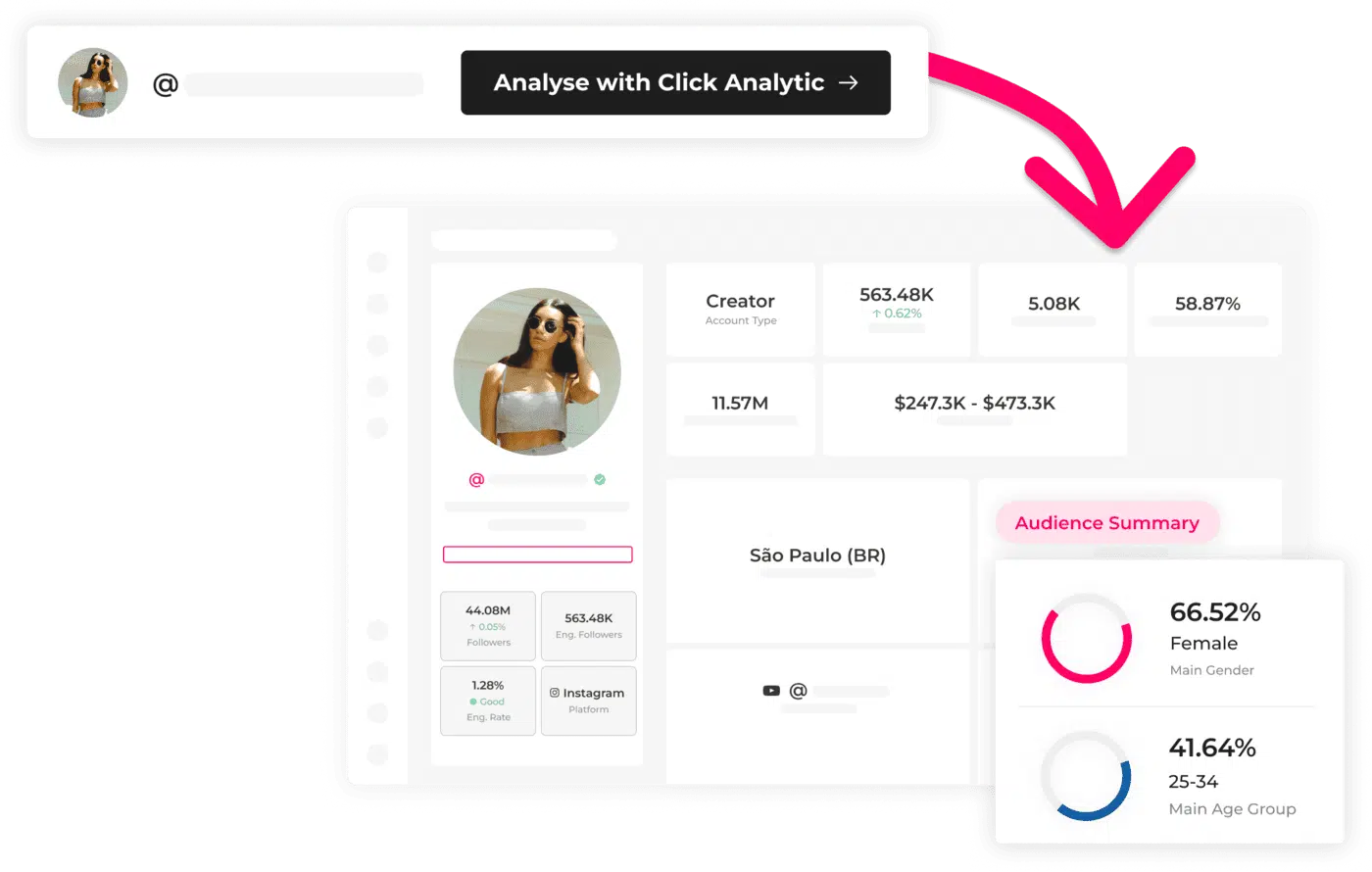
ClickAnalytic is built for teams that need discovery plus proof. It starts at $79 per month, includes a no-credit-card free trial, and gives access to 400M+ creator profiles. Core vetting features include AQS fake follower scoring, audience overlap analysis, campaign tracking with UTMs, Shopify revenue attribution, and white-label reports for client delivery.
The main fit is agencies and growing brands that need to justify creator selection with data instead of screenshots. Compared with Collabstr, the difference is not marketplace convenience, it is validation depth. The main limitation is workflow scope: ClickAnalytic is not a hiring marketplace and it is not a full gifting or seeding CRM.
Key features:
AQS fake follower detection
400M+ creator database
Audience overlap analysis
White-label reports
Campaign tracking with UTMs and Shopify revenue attribution
2026 update: ClickAnalytic remains one of the lowest-cost self-serve options with AQS scoring, overlap analysis, and white-label reporting at $79/mo.
✓ PROS
$79/mo entry price
No-credit-card free trial
400M+ creator database
AQS fake follower scoring included
Audience overlap and white-label reports
✗ CONS
No marketplace booking flow
No gifting or product seeding CRM
Less known than DR 75 to DR 78 incumbents
Built for data-first teams, not casual browsing
Best for: Agencies and growing brands that need searchable discovery, fraud checks, overlap analysis, and client-ready reporting without a $199 to $2,000+ monthly contract.
BEST FOR: Global discovery at serious scale

02. Modash
From $199/month | Limited free plan
Modash is a discovery-first platform with a DR 73 domain and a database of 380M+ profiles. It is built for in-house teams and agencies that need broad creator search across countries, cities, and niches. One visible differentiator is scale in organic discovery content: Modash has 5,774 programmatic geo-directory pages, which reflects how heavily it leans into searchable creator discovery.
It is also easier to access than most demo-led tools. Sign-up is self-serve, the free plan allows 20 profile opens, and paid plans start at $199 per month. The limitation is analytics depth. Modash is lighter than HypeAuditor on audience quality analysis, and features like content tracking and email finder start at $499+ per month. It also does not offer white-label reporting.
2026 update: Modash still wins on self-serve discovery access, but advanced tracking and outreach features sit in the $499+/mo tier.
✓ PROS
380M+ profile database
$199/mo entry plan
Self-serve sign-up
20 profile opens on free plan
5,774 geo-directory pages show strong international discovery focus
✗ CONS
Content tracking and email finder start at $499+/mo
No white-label reports
Audience quality analysis is lighter than HypeAuditor
Free plan is capped at 20 profile opens
Best for: Mid-market in-house teams and agencies that need self-serve creator discovery across many geographies, but do not need white-label reporting or the deepest fraud analysis.
BEST FOR: DTC brands with ongoing creator programs

03. GRIN
From $399/month | 30-day limited trial, demo required
GRIN is a creator CRM platform for DTC brand teams that need operations more than marketplace browsing. Public pricing starts at $399+ per month, access usually requires a demo, and the product centers on gifting, product seeding, creator contracts, and creator payments. That makes it a fit for brands running repeat creator programs with internal ops teams.
Its differentiator is workflow depth, not discovery analytics. If your team needs contracts, product shipments, and payment records in one system, GRIN covers those modules. The limitation is agency fit: there is no white-label reporting, no multi-client workspace, and no audience quality layer comparable to AQS-based tools. It is also worth noting that 69% of GRIN’s traffic comes from blog content, much of it celebrity entertainment rather than product-led education.
2026 update: GRIN remains strongest when gifting, seeding, contracts, and payments matter more than fraud scoring or overlap analysis.
✓ PROS
$399+/mo starting point
Gifting and product seeding modules
Creator contracts and payments
30-day limited trial
Built for DTC creator CRM workflows
✗ CONS
Demo required
No white-label reports
No multi-client workspace for agencies
No AQS scoring or audience overlap analysis
Best for: DTC brand teams using gifting, seeding, contracts, and payments in one creator CRM, not agencies managing multiple client accounts.
BEST FOR: Shopify brands with affiliate campaigns

04. Upfluence
Custom pricing | Demo required
Upfluence is built for ecommerce teams that want influencer activity tied to store data. It integrates with Shopify, WooCommerce, and BigCommerce, supports affiliate tracking, and references 500+ ecommerce integrations. Public pricing references often land around $478 per month, but the platform is sold through demos and custom quotes.
The clearest differentiator is commerce connectivity. If a brand needs discount codes, affiliate links, and store-linked reporting in one workflow, Upfluence is more relevant than Collabstr. The limitation is that it is ecommerce-first, not analytics-first. Free tools drive 47.6% of its traffic, and it does not stand out for audience quality scoring or overlap analysis the way HypeAuditor or ClickAnalytic do.
2026 update: Upfluence still makes the most sense when Shopify or affiliate tracking is the buying reason, not pure creator vetting.
✓ PROS
Shopify, WooCommerce, and BigCommerce integrations
500+ ecommerce integrations
Affiliate tracking and discount code workflows
Store-linked reporting
Ecommerce-first setup for DTC teams
✗ CONS
Custom pricing and demo required
Public pricing is inconsistent, often cited around $478/mo
Less compelling if you do not sell through ecommerce platforms
Not known for deep audience quality analysis
Best for: Ecommerce and DTC brands that need influencer campaigns connected to Shopify, affiliate links, and store revenue reporting.
BEST FOR: Agencies needing real fraud protection

05. HypeAuditor
From $299/month | Demo required for enterprise
HypeAuditor is built for audience quality analysis. It has a DR 77 domain, a database of 224M+ profiles, and coverage across 5 platforms: Instagram, TikTok, YouTube, Twitter, and Twitch. Its signature differentiator is AQS, Audience Quality Score, which flags suspicious follower patterns, engagement anomalies, and growth spikes.
That makes it one of the clearest upgrades from Collabstr when the main problem is fraud risk. Pricing starts at $299+ per month, and enterprise access requires a demo. The limitation is that HypeAuditor is strongest in analysis depth, not in self-serve affordability or white-label agency reporting. Teams that mainly need lower-cost discovery may find Modash or ClickAnalytic easier to adopt.
2026 update: HypeAuditor remains the reference point for AQS-led fraud detection across 5 major creator platforms.
✓ PROS
224M+ profiles
AQS fraud scoring
Suspicious follower and engagement anomaly flags
Growth spike detection
Coverage across 5 platforms
✗ CONS
$299+/mo starting price
Demo required for enterprise
Less self-serve than lower-cost tools
Not positioned around white-label agency reporting
Best for: Teams where audience quality analysis, suspicious follower detection, and engagement anomaly flags matter more than marketplace booking or CRM workflows.
BEST FOR: Brand ambassador and creator communities

06. Aspire
Custom pricing, around $2,000+/month | Demo required
Aspire is a DTC-focused platform for brands running structured creator programs. Public references place pricing around $2,000+ per month, and onboarding is typically heavier than self-serve tools. Core modules include a gifting marketplace, product seeding, creator marketplace access, and affiliate link tracking.
The product is built for brands that want repeat creator relationships and product-led workflows, not just discovery. That makes it useful for ambassador programs and seeding-heavy campaigns. The limitation is analytics depth and accessibility: Aspire is demo-led, onboarding-heavy, and not the best fit if your main need is lower-cost discovery, AQS scoring, or overlap analysis.
2026 update: Aspire still fits DTC teams that prioritize gifting and seeding workflows over self-serve discovery or fraud scoring.
✓ PROS
Gifting marketplace
Product seeding workflows
Creator marketplace access
Affiliate link tracking
Built for DTC creator programs
✗ CONS
About $2,000+/mo
Demo required
Heavy onboarding
Not built around AQS scoring or audience overlap analysis
Best for: DTC and ecommerce brands running gifting, seeding, and affiliate-led creator programs with enough budget for a $2,000+ monthly platform.
BEST FOR: Enterprise influencer governance and reporting

07. Traackr
Custom pricing, about $30K-$100K/year | Demo only
Traackr is an enterprise governance platform, not a lightweight creator search tool. Typical deals land between $30,000 and $100,000 per year, acquisition is demo-only, and onboarding often takes 6 to 12 weeks. Its core value is governance: spend reporting across markets, approval workflows, compliance controls, and multi-market campaign oversight.
That makes Traackr relevant for Fortune 500 brands running influencer programs across regions, business units, and procurement layers. The limitation is practicality. With a 7M profile database and enterprise implementation requirements, it is not a realistic fit for SMBs, most agencies, or teams that mainly need faster discovery and vetting.
2026 update: Traackr remains a governance buy for global brands, not a self-serve upgrade for teams leaving Collabstr.
✓ PROS
$30K-$100K annual enterprise contracts
Spend reporting across markets
Approval workflows and compliance controls
Multi-market campaign oversight
Built for Fortune 500 governance needs
✗ CONS
6 to 12 week implementation is common
Demo-only acquisition
7M profile database is smaller than discovery-first tools
Not practical for SMBs or most agencies
Best for: Global enterprise brands that need governance, spend accountability, and approval controls across multiple markets, not teams looking for a fast self-serve alternative to Collabstr.
BEST FOR: Small agencies doing outreach and CRM
08. Influencer Hero
From $649/month | Demo required
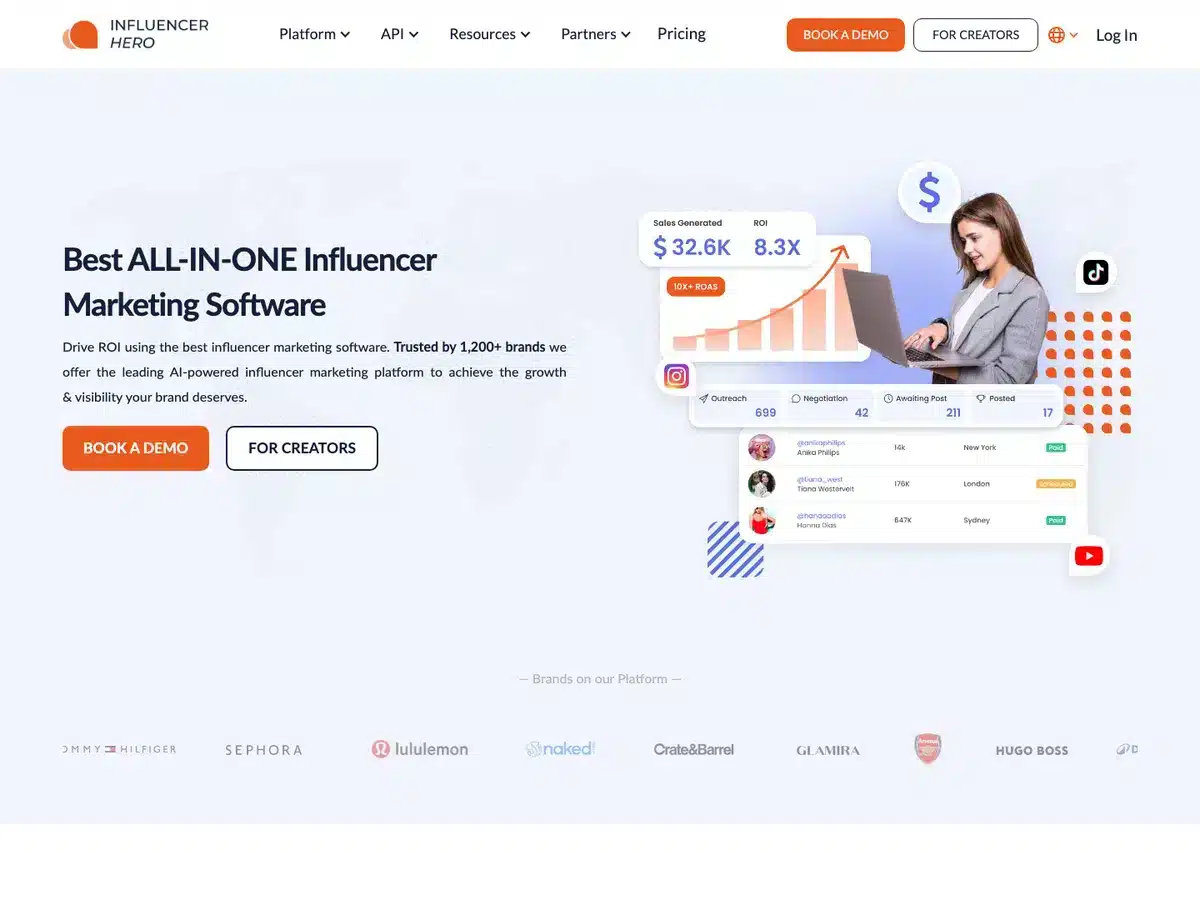
Influencer Hero is positioned around outreach and CRM workflows more than deep analytics. Its domain rating is 72, and its organic acquisition leans heavily on free tools such as a fake follower scanner and engagement calculator, plus niche top-influencer list content. That makes it easier to discover for smaller teams looking for outreach software.
The fit is agencies that want creator outreach, pipeline management, and a database in one place. The limitation is analytics depth. Compared with HypeAuditor or ClickAnalytic, Influencer Hero offers less depth in audience quality analysis and overlap-style vetting. At $649+ per month, it is also priced above several discovery-first alternatives.
2026 update: Influencer Hero remains more compelling for outreach workflows than for teams prioritizing AQS-level fraud analysis.
✓ PROS
Outreach and CRM workflow focus
Free tools help with top-of-funnel evaluation
Creator database plus outreach in one system
Useful for pipeline management
Built for teams replacing spreadsheets and manual follow-up
✗ CONS
$649+/mo starting price
Less analytics depth than HypeAuditor or ClickAnalytic
Not known for audience overlap analysis
Weaker fit if discovery vetting is the main buying reason
Best for: Agencies that need outreach automation and creator pipeline management more than advanced fraud scoring or overlap analysis.
Common Questions
What is the best Collabstr alternative overall?
Collabstr is a marketplace for booking fixed-price creator packages fast. If you need a large searchable database instead, Click Analytic is the most direct alternative: 400M+ profiles, AQS fake follower scoring, audience overlap, and white-label reports from $79/month.
Why do brands switch from Collabstr to another platform?
Reach and depth. Collabstr only surfaces creators who opted into its marketplace, a small pool with shallow analytics and no real fraud scoring. Brands switch when they need a far larger searchable index, AQS audience-quality screening, overlap analysis, and deeper reporting.
Which Collabstr alternative is best for agencies?
For agencies, Click Analytic is usually the closest fit: 400M+ searchable profiles, AQS fake follower checks, audience overlap analysis, and white-label reports. Collabstr can fill a quick UGC order, but agencies running shortlists across clients need deeper discovery and client-ready reporting.
Is there a cheaper way to work than Collabstr?
For a single booking, Collabstr is hard to beat since you pay per package, not a subscription. At volume, a discovery platform delivers more per dollar: Click Analytic starts at $79/month, Modash at $199/month, HypeAuditor at $299+/month, all with far larger searchable databases.
Can Click Analytic replace Collabstr?
It replaces the discovery, vetting, overlap, and reporting side of Collabstr, plus UTM tracking and Shopify revenue attribution. It is not a marketplace, though: no fixed-price packages, booking, contracts, or creator payments. Choose Click Analytic to search, screen, shortlist, and report.
What should I check before switching from Collabstr?
Separate booking from discovery, since they need different tools. Check how big a creator pool you need (marketplaces show opted-in creators only; databases here range 2.5M+ to 400M+), whether you screen audience quality with AQS scoring, and who handles payments and deliverables.
What questions should I ask on an influencer platform demo?
How large is the searchable database, and is it open discovery or opted-in only? Can it flag suspicious followers using named signals like AQS in-workflow? Does it analyze audience overlap across a shortlist? What can a strategist do day one, and is white-label reporting included?
Why does data coverage matter more than a marketplace catalog?
A marketplace is only as good as the creators who joined it. Searchable database size here ranges from 2.5M+ in Later Influence to 400M+ in Click Analytic, with Modash at 380M+ and HypeAuditor at 224M+, all far larger than any opt-in catalog. Broad discovery and audience signals matter as the market shifts fast.
Build your creator roster without the Collabstr fees
Start free, no demo and no credit card. Search 400M+ creators the same afternoon you sign up.
Start free