Grin Alternatives: 8 Best Platforms Compared 2026
You’ve probably come across GRIN influencer marketing software. While GRIN offers solid tools for managing influencer campaigns, it might not be the perfect fit for every brand. Many users find GRIN influencer pricing steep, its interface complex, and customer support lacking. Fortunately, there’s a better alternative that offers the same powerful features-at a more affordable price and with better ease of use. Looking for a smarter way to manage influencers? Discover the best GRIN alternative today! 🚀
Every tool, every number, one table
Pricing and features verified from public sources, June 2026.
Why look beyond GRIN
Compared for brands and agencies that prioritize searchable creator databases, audience quality checks, pricing clarity, and faster evaluation before committing to a creator management platform.
Reviewed by Paul Boulet, founder of ClickAnalytic
8 platforms compared • Pricing checked • May 2026Try ClickAnalytic Free
GRIN is strongest for teams that want creator management, gifting, contracts, payments, and reporting in one system. Buyers usually compare alternatives when discovery depth, audience vetting, pricing clarity, and agency workflow fit matter more than operating a full creator CRM from day one.
The tools, reviewed

01. ClickAnalytic
$79/month | Free trial, no CC
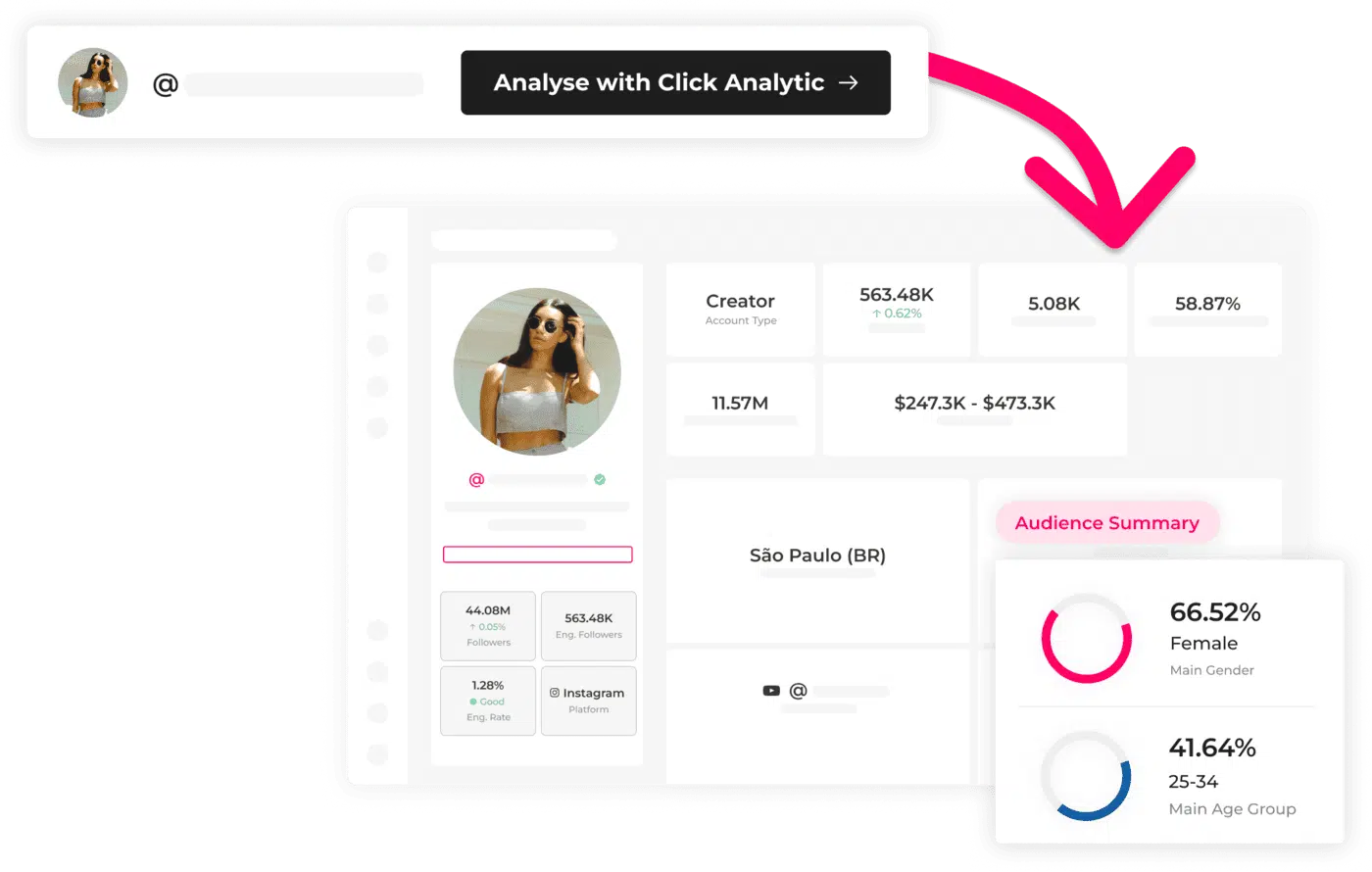
ClickAnalytic is a discovery and vetting platform for teams that need to search creators, score audience quality, compare shortlist overlap, and export reports without a sales call first. It covers Instagram, TikTok, and YouTube with 400M+ profiles and starts at $79/month.
Its clearest differentiators are AQS fake follower scoring, audience overlap analysis, white-label reports, UTM campaign tracking, and Shopify revenue attribution in one workflow. It also offers a self-serve free trial with no credit card, which GRIN does not. For agencies, that matters because GRIN does not include white-label reporting or multi-client workspace.
The limitation is product scope. ClickAnalytic does not include built-in contracts, gifting, product seeding, or creator payments. If your team runs high-volume seeding programs and needs relationship CRM first, GRIN or Aspire covers more of that operational workflow.
Key features:
400M+ influencer profiles across Instagram, TikTok, and YouTube
AQS fake follower detection
Audience overlap analysis
White-label reports
UTM campaign tracking and Shopify revenue attribution
2026 update: ClickAnalytic continues to offer self-serve access from $79/month with a no-credit-card trial, plus 400M+ searchable profiles and built-in AQS scoring.
✓ PROS
$79/month entry price
400M+ searchable profiles
AQS scoring and audience overlap included
White-label reports and no-credit-card trial
✗ CONS
No contracts module
No gifting or product seeding workflow
Less suited to enterprise creator CRM than GRIN
Best for: Agencies and growing brands that need discovery, fake follower checks, overlap analysis, and client-ready reporting from day one.
ClickAnalytic vs GRIN
ClickAnalytic is a better fit when teams need searchable creator data, audience vetting, overlap analysis, and white-label reporting before they need creator CRM. GRIN is the stronger fit when gifting, contracts, creator payments, and a heavier creator management workflow matter more than discovery-first evaluation.
Best for: Agencies prioritizing discovery scale and transparency

02. Modash
$199/month | Limited free plan
Modash is a discovery-first platform for teams that need to search large creator pools by country, city, and niche, then move into outreach support. Its database covers 380M+ profiles, and its public search footprint includes 5,774 geo and niche directory pages.
Two specific differentiators are search coverage and free utility tools. Its fake follower checker drives 44,861 visits per month, making it the top traffic page on the domain, and it also offers an engagement calculator and lookalike tool. Paid plans start at $199/month, while the free plan lets users test the product with a 20-profile opens cap.
The limitation is analytics depth. Modash is built more for discovery than for deep fraud review, and its audience vetting is lighter than HypeAuditor’s AQS, suspicious growth flags, and engagement anomaly detection. Teams that need rigorous audit workflows may outgrow it.
Key features:
380M+ influencer profiles
Programmatic geo and niche discovery across 5,774 directory pages
Fake follower checker, engagement calculator, and lookalike tool
Email finder and content tracking on higher plans
Free plan with 20-profile opens cap
2026 update: Modash remains one of the largest discovery databases at 380M+ profiles, with entry pricing from $199/month and free tools that drive most of its top-of-funnel traffic.
✓ PROS
380M+ searchable profiles
$199/month entry price
5,774 geo and niche directory pages
Useful free tools for early evaluation
✗ CONS
Free plan limited to 20 profile opens
Fraud analysis is lighter than HypeAuditor
Less built for CRM-heavy workflows than GRIN
Best for: In-house teams and agencies that need broad creator search across markets and can accept lighter fraud analytics than HypeAuditor or ClickAnalytic.
Modash vs GRIN
Modash is a better fit when discovery breadth, lighter entry pricing, and faster search-led evaluation matter more than creator CRM, gifting, and payments workflows.
Best for: Teams focused on fraud detection and audits

03. HypeAuditor
$299/month | Demo for enterprise
HypeAuditor is an analytics-led platform for fraud detection, audience quality review, and creator audits. It covers 224M+ profiles across 5 platforms: Instagram, TikTok, YouTube, Twitter, and Twitch. Compared with GRIN, it is built for verification first, not creator CRM.
Its signature differentiators are AQS, suspicious growth flags, and engagement anomaly detection. It also has the highest measured link quality ratio in this comparison at 90.4%. Pricing starts at $299+/month, and enterprise plans can reach thousands per month.
The limitation is workflow breadth. HypeAuditor’s database is smaller than ClickAnalytic’s 400M+ profiles, and the platform is heavier on analysis than on outreach, gifting, contracts, or payments. Teams that need one system for seeding and relationship management will still need GRIN, Aspire, or Upfluence.
Key features:
224M+ influencer profiles
AQS Audience Quality Score
Suspicious growth flags
Engagement anomaly detection
Coverage across 5 social platforms
2026 update: HypeAuditor remains the most fraud-focused option in this list, with AQS, anomaly detection, and 224M+ profiles across 5 platforms.
✓ PROS
AQS, growth flags, and anomaly detection
5-platform coverage
90.4% link quality ratio
Better for audits than GRIN
✗ CONS
Starts at $299+/month
224M+ profiles is smaller than ClickAnalytic’s 400M+
Not built around contracts, gifting, or payments
Best for: Teams running high-scrutiny campaigns, audits, or fraud reviews where audience quality matters more than creator CRM.
HypeAuditor vs GRIN
HypeAuditor is the stronger fit when fraud detection, audience quality scoring, and audit-heavy vetting matter more than operating a full creator CRM.
Best for: Agencies wanting ecommerce and creator CRM

04. Upfluence
Custom pricing | Demo required
Upfluence is an ecommerce-first influencer platform for brands that want influencer discovery, affiliate tracking, and store integrations in one stack. It is built mainly for Shopify, WooCommerce, and BigCommerce teams that treat influencer marketing as a revenue channel.
Its clearest differentiators are 500+ ecommerce integrations and built-in affiliate tracking. That makes it relevant for DTC teams running discount codes, ambassador programs, and store-level attribution. Public pricing references are around $478/month, but plans are custom and require a demo. Its free fake follower checker is also its top traffic page at 11,270 visits.
The limitation is fit outside ecommerce. Upfluence is more complex for non-ecommerce teams, and the value drops if you do not need Shopify, WooCommerce, BigCommerce, or affiliate workflows. Agencies that mainly need discovery and audience vetting may find the setup heavier than necessary.
Key features:
500+ ecommerce integrations
Shopify, WooCommerce, and BigCommerce support
Affiliate tracking and ambassador workflows
Creator CRM and outreach
Revenue attribution for ecommerce programs
2026 update: Upfluence remains one of the most ecommerce-specific options, with 500+ integrations and affiliate tracking as its main product differentiator.
✓ PROS
500+ ecommerce integrations
Affiliate tracking built in
Better fit than GRIN for store-led attribution
Works well for Shopify-heavy brands
✗ CONS
Custom pricing and demo required
Public pricing references around $478/month
Complex for non-ecommerce teams
Best for: DTC brands and agencies running Shopify or WooCommerce programs that need affiliate tracking and ecommerce attribution in the same platform.
Upfluence vs GRIN
Upfluence is usually compared with GRIN by teams that want a stronger ecommerce and Shopify-oriented workflow, but it is less compelling when database breadth and lower-friction evaluation matter most.
Best for: Agencies running community-led creator partnerships

05. Aspire
Custom pricing | Demo only
Aspire is a gifting-first influencer platform for DTC and ecommerce teams that run product seeding, creator recruitment, and marketplace-based sourcing. It is built for brands that want creators to apply, receive products, and move into ambassador or UGC workflows.
Its two clearest differentiators are product seeding workflow and marketplace-led creator recruitment. Public pricing references place Aspire around $2,000+/month, which puts it in the enterprise onboarding category rather than self-serve software. Compared with GRIN, it stays DTC-focused but adds a marketplace angle for recruiting creators into gifting-led campaigns.
The limitation is analytics depth. Aspire does not lead with fake follower scoring or audience overlap analysis, and the price is high if your team only needs search and vetting. If your workflow starts with fraud checks and shortlist comparison, ClickAnalytic or HypeAuditor is more direct.
Key features:
Product seeding workflow
Creator marketplace recruitment
UGC and ambassador program support
Enterprise onboarding
DTC and ecommerce campaign management
2026 update: Aspire remains a premium DTC option with gifting-first workflow and pricing commonly referenced at $2,000+/month.
✓ PROS
Built for product seeding and gifting
Marketplace helps recruit creators
Useful for UGC and ambassador programs
Closer to GRIN than analytics-only tools
✗ CONS
About $2,000+/month
No self-serve trial
Not built around fake follower scoring or overlap analysis
Best for: DTC brands running gifting, seeding, and creator recruitment programs that need a marketplace-led workflow.
Aspire vs GRIN
Aspire is a stronger fit when affiliate, gifting, and marketplace-style creator recruitment matter most, while GRIN is more centered on creator CRM and seeding operations.
Best for: Enterprise agencies managing global influencer portfolios

06. Traackr
Custom pricing | Demo only
Traackr is an enterprise governance platform for multi-market influencer programs. It focuses on spend reporting, portfolio oversight, compliance controls, and standardized reporting across regions or business units rather than self-serve discovery for smaller teams.
Its clearest differentiators are governance and budget visibility. Public pricing references place Traackr between $30,000 and $100,000 per year, which makes its target customer clear: global brands and large agencies with executive reporting requirements. Compared with GRIN, Traackr is more focused on oversight, compliance, and cross-market management than on gifting or creator relationship workflow.
The limitation is accessibility. Demo-only onboarding, enterprise pricing, and a heavier setup make Traackr a poor fit for SMBs, boutique agencies, or teams that just need creator search and audience vetting.
Key features:
Spend reporting
Multi-market oversight
Compliance controls
Portfolio-level reporting
Enterprise governance workflows
2026 update: Traackr remains one of the most enterprise-priced options in the category, with annual pricing commonly cited between $30K and $100K.
✓ PROS
$30K to $100K/year positions it for enterprise governance
Spend reporting and compliance controls
Useful for multi-market oversight
Better than GRIN for executive portfolio reporting
✗ CONS
Too expensive for SMBs
Demo-only access
Complex for teams that only need discovery and vetting
Best for: Global brands and enterprise agencies that need compliance, spend reporting, and oversight across multiple markets.
Traackr vs GRIN
Traackr is the more enterprise-oriented choice for competitive intelligence, governance, and global reporting, while GRIN is more centered on creator relationship workflows.
Best for: Agencies combining social scheduling with influencer campaigns

07. Later Influence
Custom pricing | Demo available
Later Influence is built for teams that want influencer campaigns connected to broader social planning. Its searchable creator base is about 2.5M+ profiles, so it is more relevant when your workflow already sits inside Later’s social publishing ecosystem.
Its clearest differentiators are operational alignment with social content planning and a managed-service option. That can help social teams coordinate creator campaigns with calendars, approvals, and always-on brand activity in one environment. Compared with GRIN, the appeal is workflow alignment with social scheduling, not deeper analytics.
The limitation is discovery and vetting depth. With 2.5M+ profiles and no included fake follower scoring or audience overlap in this comparison, Later Influence is not the best choice for teams that need large-scale sourcing or fraud analysis first.
Key features:
2.5M+ creator profiles
Social planning alignment
Campaign workflow tools
Managed service option
Creator communication support
2026 update: Later Influence remains more relevant for social-first teams than for discovery-first teams, with a smaller 2.5M+ creator database.
✓ PROS
Connects influencer work to social planning
2.5M+ creator profiles
Useful for always-on social teams
Managed service option available
✗ CONS
Much smaller database than ClickAnalytic, Modash, or HypeAuditor
No included fake follower scoring in this comparison
Not ideal for deep vetting workflows
Best for: Social-first teams that want influencer campaigns tied to publishing calendars and do not need a large discovery database.
Later Influence vs GRIN
Later Influence is a better fit for social-first teams that want campaign support tied to publishing workflows, while GRIN is better known for in-house creator CRM and operations.
Best for: Small agencies needing all-in-one influencer management
08. Influencer Hero
$649/month | Demo available
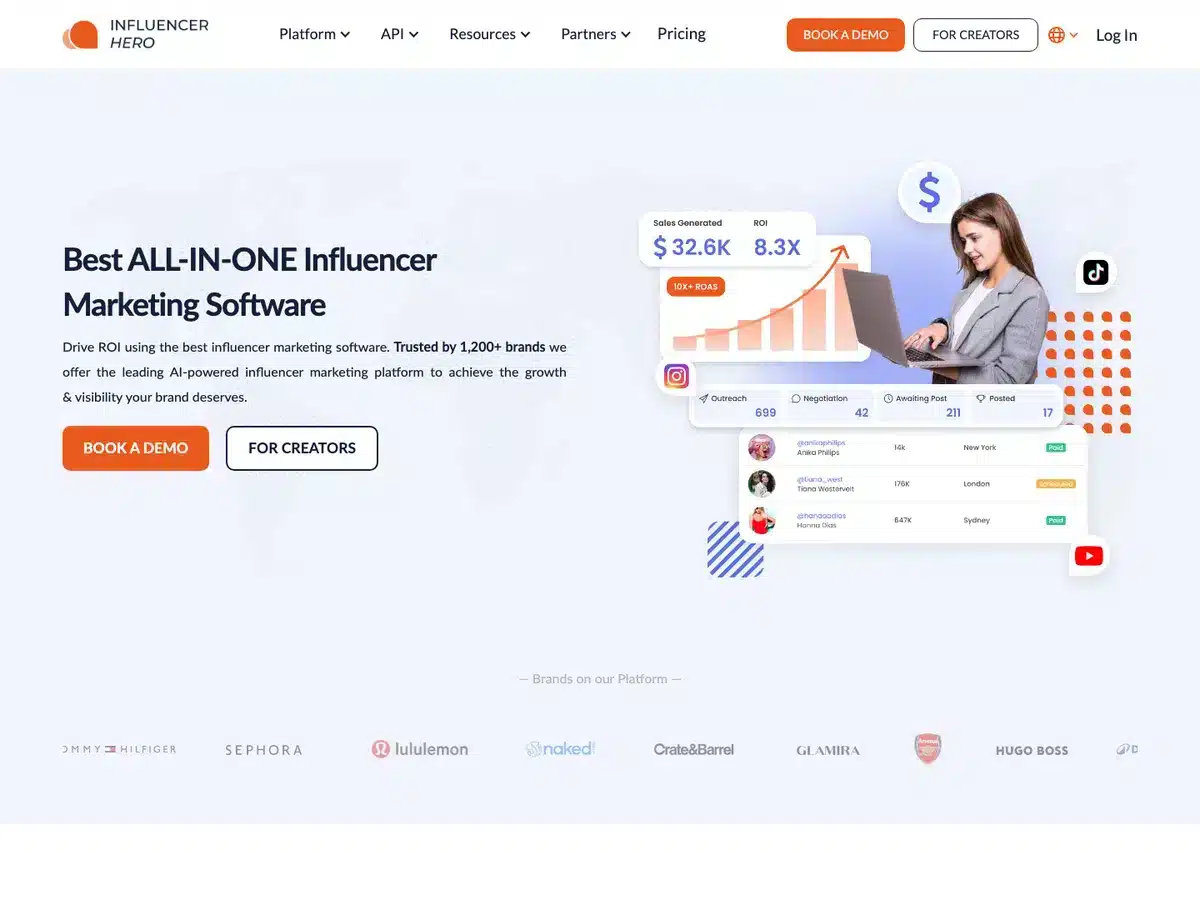
Influencer Hero is an all-in-one platform that combines discovery, outreach, CRM, gifting, and reporting for smaller teams that want one system instead of a specialist analytics tool. It claims 450M profiles and starts at $649/month.
Its clearest differentiators are workflow breadth and free tools. The platform gets visibility from a free-tools section, including a fake follower scanner and engagement calculator, plus list-style discovery content such as /top-influencers/ pages. That means its acquisition model is more content-led than search-tool-led.
The limitation is analytics depth. Influencer Hero does not match HypeAuditor’s fraud stack or ClickAnalytic’s audience overlap analysis, and audience overlap is not included in this comparison set. Teams paying $649/month mainly for discovery and vetting may find more direct options elsewhere.
Key features:
450M claimed creator profiles
Outreach and email automation
Creator CRM and gifting workflows
Free tools including fake follower scanner and engagement calculator
Campaign reporting tools
2026 update: Influencer Hero continues to position itself as an all-in-one option for smaller teams, with pricing from $649/month and a content-led discovery approach.
✓ PROS
Claims 450M profiles
Includes outreach, CRM, and gifting
Free tools help with top-of-funnel evaluation
More approachable than GRIN for smaller teams
✗ CONS
Starts at $649/month
Less analytics depth than HypeAuditor or ClickAnalytic
No audience overlap included in this comparison
Best for: Small teams that want outreach, CRM, and campaign workflow in one tool and can accept lighter analytics than specialist vetting platforms.
Influencer Hero vs GRIN
Influencer Hero fits outreach-heavy teams that want CRM and campaign workflow in one place, while GRIN remains more creator-operations-oriented and heavier overall.
Related: Best Impact Alternatives
Common Questions
What is the best GRIN alternative overall?
It depends on your use case. For 400M+ searchable profiles, AQS fake follower scoring, audience overlap analysis, and white-label reports from $79/month, Click Analytic is the most direct alternative. For creator CRM with gifting, contracts, and payments, Aspire or Upfluence are closer.
Why do brands switch from GRIN to another platform?
Mostly price, workflow fit, and agency limits. GRIN starts at $399+/month, requires a sales process, and has no white-label reporting or multi-client workspace. Teams also switch when they need discovery and audience vetting before CRM.
Which GRIN alternative is best for agencies?
Click Analytic is usually the closest fit, combining 400M+ profiles, AQS fake follower checks, audience overlap analysis, white-label reports, and no-credit-card trial access. GRIN is built for in-house DTC teams, not agency workspace structure.
Are there cheaper alternatives to GRIN?
Yes. Click Analytic starts at $79/month and Modash at $199/month, both below GRIN’s $399+/month entry point. HypeAuditor starts at $299+/month. Feature depth differs by platform.
Can Click Analytic fully replace GRIN?
For discovery, audience vetting, overlap analysis, white-label reporting, UTM tracking, and Shopify revenue attribution, yes. It is not a full replacement if your team depends on built-in contracts, gifting, product seeding, and creator payments.
What should I check before switching from GRIN?
Map where GRIN is actually used today and separate CRM workflows (product sends, affiliate links, relationship tracking) from discovery. If your briefs change monthly by category, region, or audience, a larger search database matters more. Also check whether audience quality and overlap are being reviewed before renewal.
What questions should I ask on an influencer platform demo?
Ask how large the searchable database is and how many profiles include full audience analytics, not just contacts. Can it flag suspicious followers inside discovery rather than as a manual step? Can it show audience overlap across a shortlist? And what can your team do on day one without a long onboarding?
How should I weigh AI claims against creator data?
Weigh methodology over AI language. Creator quality is rarer than marketing implies: just 1% of Instagram creators have 90%+ real followers, and only 0.47% meet 90%+ real plus 2%+ engagement. GRIN publishes little on its scoring. Click Analytic offers a 14-day free trial, no credit card, to compare directly.
A GRIN-class workflow at a starter price
Start free, no demo and no credit card. Search 400M+ creators the same afternoon you sign up.
Start free