8 Best Upfluence Alternatives in 2026
Upfluence alternatives: 8 platforms compared by price, database, fake follower detection, and trial access. Real 2026 pricing included.
Every tool, every number, one table
Pricing and features verified from public sources, June 2026.
Why look beyond Upfluence
If you are comparing Upfluence alternatives, you are likely looking for lower pricing, faster onboarding, or a tool that does not require a full ecommerce workflow stack. This list compares starting price, searchable profiles, fake follower checks, audience overlap, and trial access, with options starting at $79 per month.
Most buyers comparing Upfluence alternatives are choosing between two product types: ecommerce platforms with affiliate tracking and creator payments, or discovery-led tools focused on search, audience vetting, and reporting. Upfluence is built for ecommerce teams with 500+ integrations across Shopify, WooCommerce, and BigCommerce, plus affiliate tracking. Teams that mainly need creator search, fake follower checks, audience overlap, and client-ready reporting usually compare it with lower-cost discovery platforms.
Disclosure: ClickAnalytic is our product. We include it because it is a genuine alternative, and we believe the comparison is fair and accurate. All other tools are included objectively based on market presence and relevance.
The tools, reviewed

01. ClickAnalytic
From $79/month | Free trial, no CC
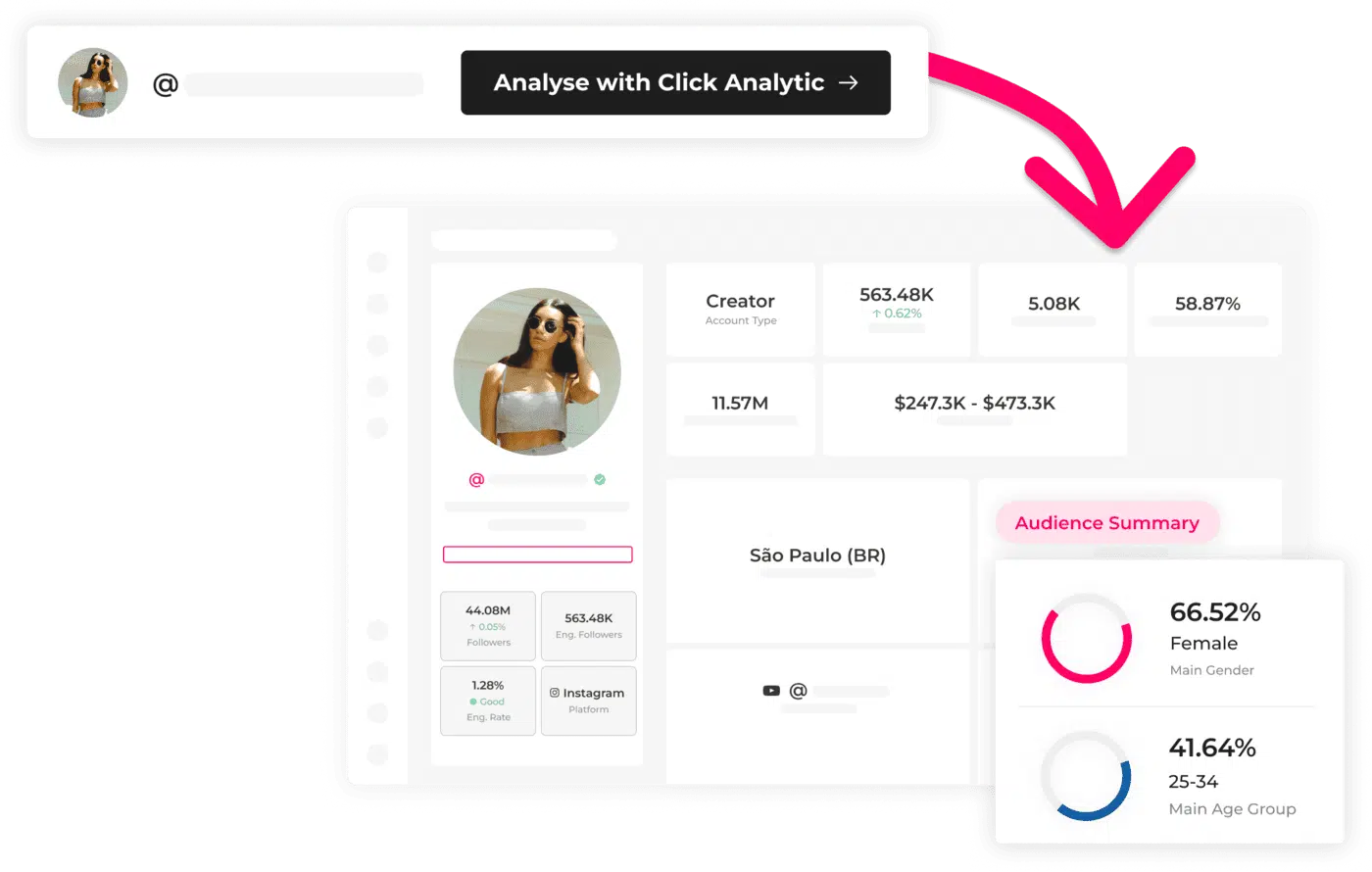
ClickAnalytic is a self-serve influencer discovery and vetting platform for agencies and growing brands that need to search creators, check audience quality, and export client-ready reports without booking a demo. It gives immediate access to 400M+ profiles across Instagram, TikTok, and YouTube. Core features include AQS fake follower scoring, audience overlap analysis, white-label reports, UTM campaign tracking, and Shopify revenue attribution.
Two practical differences versus Upfluence are price and agency workflow. ClickAnalytic starts at $79 per month, compared with public Upfluence references around $478 per month. ClickAnalytic also includes white-label reports and audience overlap analysis, which matter for agencies presenting shortlists and avoiding duplicated reach across creators. The limitation is scope: it is not a CRM-first system for gifting, contracts, creator payments, or long-term relationship management.
ClickAnalytic is built for teams that need to move from brief to shortlist quickly. Agencies can search 400M+ profiles, filter by creator attributes, review AQS scores, compare audience overlap, and export white-label reports without switching into a separate reporting tool. Brands that care about campaign measurement can also use UTMs and Shopify revenue attribution to connect creator activity to tracked sales.
Compared with Upfluence, ClickAnalytic removes the ecommerce-heavy setup. Upfluence is built around 500+ integrations and affiliate workflows. ClickAnalytic is built around discovery, vetting, reporting, and tracked campaign performance. The tradeoff is clear: if your team needs gifting, contracts, and creator payments in the same system, Upfluence or GRIN will cover more operational workflow.
For agencies comparing cost against usable analytics, ClickAnalytic combines 400M+ searchable profiles with AQS scoring and overlap analysis at the lowest public starting price in this list. That makes it a fit for multi-client prospecting, shortlist building, and reporting, rather than ecommerce-heavy creator operations.
Key features:
400M+ influencer profile database
AQS fake follower detection
Audience overlap analysis
White-label reports
Campaign tracking with UTMs and Shopify revenue attribution
2026 update: In 2026, ClickAnalytic expanded profile coverage past 400M and added deeper agency reporting workflows with white-label exports and revenue attribution.
✓ PROS
$79/month starting price is the lowest on this list
400M+ profiles across 3 platforms
Includes AQS scoring and audience overlap
White-label reports included for client delivery
✗ CONS
No CRM-first module for contracts and gifting
Not centered on affiliate program management
Less enterprise governance than Traackr
Best for: Agencies and growing brands that need self-serve discovery, audience vetting, and white-label reporting from $79 per month.
ClickAnalytic vs Upfluence
ClickAnalytic starts at $79/month with a free trial and no credit card. Upfluence is usually cited around $478/month, requires a demo, and is built around 500+ ecommerce integrations plus affiliate tracking. If your workflow is discovery, vetting, overlap checks, and reporting, ClickAnalytic gets you there faster.
Try ClickAnalytic Free, 14 Days
BEST FOR: Teams prioritizing creator search and analytics

02. Modash
From $199/month | Limited free plan
Modash is a discovery-first platform for in-house teams that need large-scale creator search without buying an ecommerce operating system. Its database covers 380M+ profiles, and its discovery structure is built around 5,774 country, city, and niche directory pages. It also offers free tools including a fake follower checker, engagement calculator, and lookalike tool. The fake follower checker alone drives 44,861 monthly visits, which shows that search-led vetting is a core part of the product.
Its clearest differentiators are searchable scale and geo discovery. Modash lists 380M+ profiles, which is larger than HypeAuditor’s 224M+, and its entry plan starts at $199 per month. The limitation is analytics depth: it is lighter than HypeAuditor for fraud analysis, and the free plan caps usage at 20 profile opens before upgrade.
See our full breakdown: Modash alternatives ranked.
Modash is built for teams that want to search by market, niche, and creator type, then move shortlisted creators into outreach or campaign tracking. Higher plans add content tracking and an email finder, with pricing rising from $199 per month to $499+ per month. That makes it more suitable for mid-market teams that want discovery first and execution second.
Compared with Upfluence, Modash removes affiliate tracking and the ecommerce integration layer. It is a better fit for teams that do not need Shopify, WooCommerce, or BigCommerce workflows. The tradeoff is that its analytics stack is not as audit-heavy as HypeAuditor, and its free access is narrow enough that most serious evaluations will hit the 20-profile limit quickly.
Compared with Upfluence, Modash is less focused on affiliate tracking and ecommerce integrations and more focused on search, list building, and practical creator discovery. That makes it a better fit for teams that do not need a commerce stack.
Key features:
380M+ influencer profiles
5,774 geo and niche directory pages
Fake follower checker, engagement calculator, and lookalike tool
Campaign tracking and email finder on higher plans
Free plan with 20 profile opens
2026 update: In 2026, Modash remained one of the largest discovery databases at 380M+ profiles and continued expanding its geo-directory footprint across 5,774 search pages.
✓ PROS
380M+ profiles for broad discovery coverage
$199/month entry price is below HypeAuditor and GRIN
44,861 monthly visits to its fake follower checker show real search demand
Useful geo and niche discovery structure with 5,774 pages
✗ CONS
Free plan caps usage at 20 profile opens
Analytics depth is lighter than HypeAuditor
Content tracking and email finder require higher-tier plans up to $499+
Best for: Mid-market in-house teams that need 380M+ searchable profiles and geo-led discovery from $199 per month.
BEST FOR: Agencies focused on fraud checks and auditing

03. HypeAuditor
From $299/month | Demo required for enterprise
HypeAuditor is an audit-first platform for teams that want fraud detection before approving creator spend. Its searchable database covers 224M+ profiles across 5 platforms: Instagram, TikTok, YouTube, Twitter, and Twitch. Signature features include AQS, suspicious growth flags, and engagement anomaly detection, which are designed to identify inflated audiences and unusual performance patterns.
Its main differentiator is fraud analysis depth. HypeAuditor also has the highest reported link quality ratio in this comparison at 90.4%. The limitation is cost and access: plans start at $299 per month, enterprise plans can reach thousands per month, and enterprise access requires a demo.
HypeAuditor is built for agencies and enterprise teams that need to justify creator approvals with named fraud signals, not just follower counts and engagement rates. AQS, suspicious growth flags, and engagement anomaly detection give buyers a specific audit workflow before contracts are signed. Coverage across 5 platforms also makes it useful for teams buying beyond Instagram and TikTok.
Compared with Upfluence, HypeAuditor is less about ecommerce execution and more about risk reduction. Upfluence focuses on affiliate tracking, store integrations, and creator payments. HypeAuditor focuses on whether the audience looks credible enough to justify spend. The tradeoff is database size and price: 224M+ profiles is smaller than ClickAnalytic’s 400M+ and Modash’s 380M+, and the entry price starts at $299 per month.
Traffic patterns also show where the product is used: 63.7% of traffic goes to directory and influencer profile pages, 21.5% to free tools, and 6.9% to the blog. That mix reflects a discovery and audit workflow rather than a commerce workflow.
Key features:
224M+ profiles across 5 platforms
AQS audience quality scoring
Suspicious growth flags
Engagement anomaly detection
Campaign and benchmark reporting
2026 update: In 2026, HypeAuditor remained the most audit-focused option in this list, with 224M+ profiles and 90.4% link quality ratio, the highest among the competitors reviewed.
✓ PROS
AQS, growth flags, and anomaly detection are purpose-built fraud checks
Covers 5 platforms, more than ClickAnalytic and Modash
90.4% link quality ratio is the highest in this comparison
Useful for client-facing audit justification
✗ CONS
224M+ profiles is smaller than ClickAnalytic’s 400M+ and Modash’s 380M+
Starts at $299/month
Enterprise access requires a demo and can cost thousands per month
Best for: Agencies and enterprise teams that need AQS scoring, suspicious growth detection, and 5-platform fraud analysis from a $299+ starting point.
BEST FOR: Ecommerce brands managing gifting and creator relationships

04. GRIN
From $399/month | Demo required
GRIN is a CRM-first influencer platform for DTC brand teams that run gifting, product seeding, creator payments, contracts, and long-term relationship management. Its main modules are gifting, product seeding, creator payments, contracts, and relationship CRM. Public pricing starts around $399 per month, and access usually begins with a demo, although a limited 30-day trial is referenced publicly.
Its clearest differentiator is operational workflow for product-led creator programs. Teams sending inventory and managing repeat partnerships get more value from GRIN’s CRM structure than from a search-only tool. The limitation is agency fit: GRIN does not offer white-label reporting or a multi-client workspace, so it is not built for agencies managing several brands from one account.
GRIN is built for embedded ecommerce teams that treat creators as an ongoing channel, not a one-off list-building exercise. Product seeding, gifting, payments, and contracts sit inside the same workflow, which makes it useful when creators receive inventory and move through repeat campaigns. That is a different use case from ClickAnalytic, Modash, or HypeAuditor, which are more discovery and vetting oriented.
Compared with Upfluence, GRIN is still ecommerce-led, but it is more CRM-first than integration-first. Upfluence emphasizes 500+ ecommerce integrations and affiliate tracking. GRIN emphasizes creator relationship records and operational tasks. The tradeoff is that agencies lose two features they often need, white-label reporting and multi-client workspace support.
Its content footprint also shows a brand-led audience rather than a product-led one. About 69% of traffic comes from blog content, including celebrity and entertainment articles such as Love Island cast lists and TikTok history pieces, not product education pages.
Key features:
Creator relationship CRM
Gifting and product seeding workflows
Creator payments and contracts
30-day limited trial
DTC brand workflow support
2026 update: In 2026, GRIN remained a CRM-first DTC platform with public pricing starting around $399/month and a feature set centered on gifting, seeding, payments, and contracts.
✓ PROS
Built around gifting, seeding, payments, and contracts
$399+ pricing is lower than Aspire’s reported $2,000+
Useful for embedded DTC teams running repeat creator programs
30-day limited trial is more accessible than demo-only enterprise tools
✗ CONS
No white-label reporting for agencies
No multi-client workspace
Not built for agencies switching across accounts
Best for: DTC brand teams that run gifting and product seeding at scale and need CRM, payments, and contracts in one platform.
BEST FOR: Brands and agencies running ambassador programs

05. Aspire
Custom pricing | No trial
Aspire is built for ecommerce and DTC teams that run gifting-first creator programs, ambassador recruitment, and product seeding through enterprise onboarding. Public pricing references usually start around $2,000+ per month. The platform is designed for brands that want creators to move through a structured lifecycle that includes recruitment, seeding, approvals, and repeat collaboration.
Its clearest differentiators are gifting-first workflow and a product seeding marketplace. That makes Aspire relevant for brands where UGC, ambassador programs, and seeding are tied directly to ecommerce operations. The limitation is cost and setup: there is no self-serve trial, pricing is custom, and onboarding is heavier than GRIN, Modash, or ClickAnalytic.
Aspire is built for brands that want creators sourced and managed inside a seeding-heavy workflow, not just discovered in a database. The marketplace layer helps recruit creators for product-led partnerships, while the gifting-first structure supports repeat ambassador and UGC programs. That makes it more operational than discovery-first tools and more expensive than most alternatives in this list.
Compared with Upfluence, Aspire is not a simplification play. Both products are ecommerce-led. Aspire becomes relevant when a team wants a more structured seeding and ambassador workflow and can justify enterprise pricing around $2,000+ per month. If the goal is lower cost or lighter onboarding, Aspire moves in the opposite direction.
Compared with Upfluence, Aspire is still ecommerce-led, so it is not the right switch if your goal is to remove commerce complexity. It is a better fit when you want a more structured seeding and ambassador workflow, not when you want a cheaper discovery tool.
Key features:
Gifting-first creator workflows
Product seeding marketplace
Ambassador and repeat collaboration management
Enterprise onboarding
DTC and ecommerce program support
2026 update: In 2026, Aspire continued to sit in the enterprise DTC tier, with public pricing references around $2,000+ per month and a workflow centered on gifting and product seeding.
✓ PROS
Built for gifting-first and seeding-heavy programs
Supports ambassador and repeat creator workflows
Relevant for ecommerce brands combining UGC and influencer programs
Marketplace model helps with product-led recruitment
✗ CONS
Public pricing references start around $2,000+/month
No self-serve trial
Enterprise onboarding adds setup time for smaller teams
Best for: DTC brands running gifting-first ambassador and product seeding programs with enterprise budgets.
BEST FOR: Enterprise teams needing strategic influencer intelligence

06. Traackr
Custom pricing | Demo only
Traackr is built for enterprise teams that need governance, spend reporting, compliance controls, and multi-market oversight across large influencer programs. Public pricing references usually place it between $30,000 and $100,000 per year. The product is designed for organizations that need centralized visibility across regions, markets, and internal teams rather than just creator discovery.
Its clearest differentiator is governance. Spend reporting, compliance controls, and multi-market oversight matter when influencer activity is reviewed by procurement, legal, or regional marketing leads. The limitation is complexity and price: it is demo-only, expensive for SMBs, and usually too heavy for agencies that mainly need search and vetting.
Traackr is built for companies running influencer programs across multiple countries, business units, or regulated approval processes. Features such as spend reporting and compliance controls are useful when finance, procurement, or legal teams need visibility into creator budgets and approvals. That is a different buying context from a brand or agency that mainly needs to find creators and export a shortlist.
Compared with Upfluence, Traackr is less about ecommerce execution and more about executive oversight. Upfluence connects influencer activity to ecommerce systems. Traackr connects influencer activity to governance and reporting structures. The tradeoff is cost: public references of $30,000 to $100,000 per year put it far above self-serve tools and most mid-market platforms.
If your team needs a platform for budget oversight across multiple countries, Traackr is one of the few tools in this list built for that use case. If you need fast creator sourcing, it is usually more system than you need.
Key features:
Spend reporting
Compliance controls
Multi-market oversight
Enterprise measurement dashboards
Demo-led onboarding
2026 update: In 2026, Traackr remained an enterprise governance platform with public pricing references in the $30K to $100K annual range and a feature set focused on oversight rather than self-serve discovery.
✓ PROS
Built for spend reporting and compliance controls
Supports multi-market oversight for global teams
Useful when procurement and legal need reporting visibility
Better fit than Upfluence for governance-heavy programs
✗ CONS
Public pricing references range from $30K to $100K per year
Demo-only buying process
Too complex for most SMBs and agencies
Best for: Enterprise teams that need governance, compliance, and spend oversight across multiple markets.
BEST FOR: Social-first teams wanting creator campaign simplicity

07. Later Influence
Custom pricing | Demo only
Later Influence is the influencer marketing product inside Later, and it is built for social teams that want creator campaigns connected to broader social planning workflows. Public references usually place pricing around $500+ per month, with a database of roughly 2.5M+ creators. That profile count is much smaller than ClickAnalytic, Modash, HypeAuditor, or Upfluence, so the product is more relevant for teams that value managed workflow and social alignment over raw discovery scale.
Its clearest differentiator is workflow fit for teams already using Later for content planning. The limitation is database size and analytics depth: 2.5M+ creators is narrow for broad prospecting, and it does not offer the fraud analysis depth of HypeAuditor or the scale of ClickAnalytic and Modash.
Later Influence is built for brands that want influencer campaigns managed alongside social publishing and planning. If a team already uses Later for content operations, the workflow connection can matter more than raw creator count. That makes it a practical option for social-first teams that prioritize coordination over large-scale search.
Compared with Upfluence, Later Influence is less ecommerce-led and more campaign coordination-led. Compared with discovery-first tools, its smaller 2.5M+ creator database becomes the main constraint. Teams searching across multiple niches or countries will usually hit that limit faster than they would in a 224M+, 380M+, or 400M+ database.
If your team already plans social content in Later, the integration story may matter more than profile count. If discovery breadth is the priority, the smaller database becomes a constraint quickly.
Key features:
2.5M+ creator database
Influencer campaign management
Creator coordination workflows
Alignment with social planning tools
Managed-service friendly onboarding
2026 update: In 2026, Later Influence remained a social-workflow option with a roughly 2.5M+ creator database and pricing references around $500+ per month.
✓ PROS
Fits teams already using Later for social planning
Useful for creator coordination inside broader social workflows
Less ecommerce-centric than Upfluence
Can work well for managed-service style programs
✗ CONS
2.5M+ creators is one of the smallest databases in this list
Custom pricing with demo-led access
No advanced fraud scoring or audience overlap analysis listed here
Best for: Social teams that want creator campaigns tied to social planning workflows more than large-scale creator discovery.
BEST FOR: Small agencies wanting broad all-in-one coverage
08. Influencer Hero
From $649/month | No trial
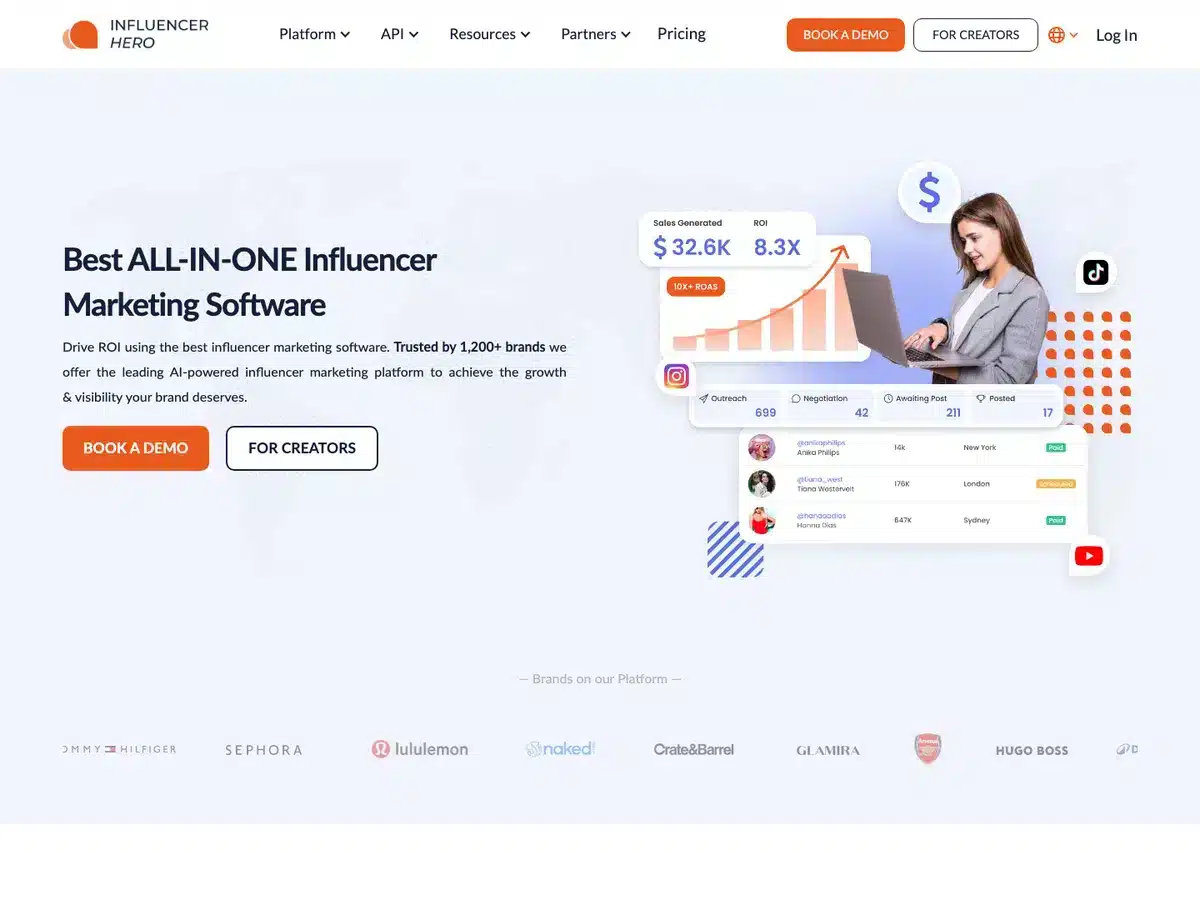
Influencer Hero is an all-in-one platform aimed at teams that want discovery, outreach, CRM, and reporting in one system. Public pricing starts around $649 per month, and the platform claims a 450M profile database. Its acquisition model leans on free tools such as a fake follower scanner and engagement calculator, plus list-style content under /top-influencers/ pages.
Its clearest differentiator is workflow breadth at a price below enterprise suites like Aspire and Traackr. It can fit agencies that want outreach and CRM in the same product as discovery. The limitation is analytics depth: it does not match HypeAuditor or ClickAnalytic on vetting depth, and audience overlap analysis is not a named core feature.
Influencer Hero is built for teams that want one system for creator discovery, outreach, CRM, and reporting, rather than a specialist discovery tool plus separate outreach software. Its free tools section includes a fake follower scanner and engagement calculator, and its content strategy relies heavily on niche list pages under /top-influencers/. That points to a content-led discovery funnel rather than a search-tool-led one.
Compared with Upfluence, Influencer Hero can be easier to justify for teams that want a broader all-in-one workflow without moving straight into a custom enterprise contract. Compared with ClickAnalytic, Modash, or HypeAuditor, it is more expensive at $649+ per month and less specialized in analytics. That makes it more suitable for agencies prioritizing outreach workflow than for teams prioritizing fraud analysis.
Compared with Upfluence, it can be easier to justify if you want a broader all-in-one tool without going straight into a custom enterprise contract. Compared with discovery-first tools, it is more expensive and less specialized in analytics.
Key features:
450M claimed influencer database
Outreach and email automation
Creator CRM tools
Fake follower scanner and engagement calculator
Campaign reporting dashboard
2026 update: In 2026, Influencer Hero continued to position itself as an all-in-one platform with a claimed 450M profile database, free vetting tools, and pricing starting around $649 per month.
✓ PROS
Combines discovery, outreach, CRM, and reporting
Claimed 450M profile coverage is large on paper
Includes free tools such as fake follower scanner and engagement calculator
Can suit agencies that want one system for outreach and execution
✗ CONS
$649/month is higher than ClickAnalytic, Modash, HypeAuditor, and GRIN entry pricing
Less analytics depth than HypeAuditor or ClickAnalytic
No audience overlap analysis highlighted as a core feature
Best for: Smaller agencies that want outreach, CRM, and discovery in one platform and can justify a $649+ monthly starting point.
Common Questions
What are the best Upfluence alternatives for smaller budgets?
Click Analytic is the lowest-priced option here at $79 per month, with 400M+ searchable profiles, AQS fake follower scoring, audience overlap analysis, white-label reports, and campaign tracking. Modash starts at $199 and HypeAuditor at $299.
Why do companies switch from Upfluence?
Mostly pricing, onboarding friction, and ecommerce complexity. Upfluence is often cited around $478 per month, requires a demo, and is built around 500+ ecommerce integrations plus affiliate tracking, so teams that do not need those workflows move to discovery-focused tools.
Is Click Analytic better than Upfluence?
For teams that need self-serve access, lower entry pricing, and agency vetting, yes. Click Analytic starts at $79 per month with 400M+ profiles, AQS scoring, audience overlap, and white-label reports. Upfluence is better for ecommerce brands wanting affiliate tracking and 500+ store integrations.
Which Upfluence competitor is best for influencer discovery?
For pure scale, Click Analytic and Modash lead with 400M+ and 380M+ profiles. For fraud-focused discovery, HypeAuditor adds AQS, suspicious growth flags, and engagement anomaly detection across 5 platforms. Pick based on database size, fraud depth, or agency reporting.
Does Upfluence have transparent pricing?
No. Upfluence does not publish self-serve pricing; public references place entry around $478 per month, but exact costs require a sales call. Click Analytic is $79 per month, Modash $199, HypeAuditor $299, and GRIN $399.
What should I check before switching from Upfluence?
Check how much of your value comes from Shopify, WooCommerce, BigCommerce, and affiliate tracking versus actual discovery, since Upfluence’s differentiator is its 500+ ecommerce integrations. Then test database depth for your niches and confirm self-serve trial access before committing.
What questions should I ask on an influencer platform demo?
Ask how many creators are searchable on the platforms you actually buy, whether you can vet audience quality in-profile (AQS, suspicious growth flags), how fast a strategist can shortlist without help, and the exact path from trial to paid plan plus usage caps.
Why does AI language matter less than data coverage?
Because discovery quality depends on searchable profile coverage, not AI copy. Database size here ranges from 2.5M+ creators in Later Influence to 400M+ in Click Analytic, with Modash at 380M+ and HypeAuditor at 224M+, and the creator market changes fast.
Switch from Upfluence, keep the depth
Start free, no demo and no credit card. Search 400M+ creators the same afternoon you sign up.
Start free